
How Collective Bargaining Could Stabilize College Football
And why the incentives, power, and political economy of college athletics make it unlikely, at least for now...

Executive Summary (for readers who want the short version of the argument upfront):
College athletics is widely described as broken, unstable, or ungovernable—yet it remains more popular, lucrative, and visible than ever. Collective bargaining for student-athletes is often proposed as a solution to many of the problems. This essay asks not whether collective bargaining is normatively desirable, but why, despite its surface logic, it remains so difficult to realize under current conditions.
The answer, from a political economy perspective, lies in misaligned incentives and power. Modern college athletics increasingly rewards individual exit over collective voice. Elite athletes, particularly in football and men’s basketball, possess individualized leverage through NIL markets and transfer mobility, reducing incentives to accept collective constraints. Meanwhile, athletes who would benefit most from stability often lack the power to organize it.
Institutions face strong fiduciary incentives to avoid categorical regulation in an environment shaped by antitrust scrutiny and Title IX. Further, as centralized authority erodes, governance has shifted toward procedural openness—discretion, case-by-case accommodation, and ambiguity—rather than enforceable limits. The transfer portal exemplifies this adaptation. It’s not chaos but really it’s risk management.
The result is a political coordination failure rather than a simple market failure. Congress is the only actor capable of authorizing a system-wide solution, yet political incentives strongly discourage intervention. Those with power benefit from legal and institutional ambiguity; those who would benefit from collective stability lack power.
Paradoxically, the same forces that make collective bargaining unworkable today may eventually make it unavoidable—at least in high-revenue football. But until institutional conditions change, collective bargaining remains more attractive in theory than viable in practice.
The Full Article
NB: This essay is written in my capacity as a political scientist who studies institutions, incentives, and collective action, not as an institutional spokesperson.
Over the past several weeks, I’ve been asked some version of the same question by people across college athletics—fans, coaches, administrators, and former athletes alike: why does a system so visible, so valuable, and so deeply loved feel so ungovernable? And closely related: if everyone agrees something is broken, why does nothing seem to fix it?
One answer that reliably surfaces is collective bargaining for athletes. The puzzle is not why that idea appeals, but why—despite its surface logic—it remains so difficult to realize in practice.
Part of the confusion stems from how loosely the term is often used. In abstract terms, collective bargaining would require athletes to be recognized as employees, the formation of a defined bargaining unit, and negotiations over compensation, working conditions, and mobility rules. In professional sports, such arrangements trade revenue sharing for stability, enforceable contracts, and cost control. None of these institutional conditions currently exist at scale in college athletics, which helps explain why collective bargaining remains an idea easier to invoke in conversation than to implement in reality.
To understand why, it helps to start with what college athletics has actually been. The system has never been orderly in a strict sense. For decades, the NCAA governed through a combination of formal rules, informal norms, selective enforcement, and shared understandings that were often strained but rarely collapsed outright. Stability depended less on coherence than on mutual restraint: universities and their athletic departments tolerated gray areas, athletes operated within compensation limits tied to scholarships, and the courts largely stayed out of the way.
What distinguishes the current moment is not the emergence of conflict, but the erosion of those informal stabilizers without a replacement governance structure to take their place. Courts have dismantled core restrictions on athlete compensation and mobility. Name, Image, and Likeness (NIL) markets have professionalized recruiting. Transfer rules now permit near-frictionless exit. Administrators and coaches increasingly describe the system as unstable, incoherent, and unsustainable.
And yet, meaningful collective bargaining between student-athletes and institutions remains distant—and may never arrive in the form many observers assume. Why?
This absence is often attributed to administrative resistance, cultural inertia, or congressional dysfunction. Those explanations capture part of the story, but they miss the deeper structural problem. The contemporary college athletics system is organized in ways that actively discourage collective action, even as it becomes more professionalized, more legally constrained, and more economically stratified.
At issue is not simply the behavior of individual actors, but the institutional environment in which they operate. Universities, conferences, and the NCAA make decisions within a layered set of legal, regulatory, and normative constraints—antitrust law, Title IX, tax status, judicial oversight—that shape incentives and narrow available choices. These frameworks do not merely regulate behavior; they structure what kinds of coordination are feasible in the first place.
Collective bargaining is not failing to happen because it lacks logic or appeal.
It is failing to happen because, under current conditions, it is structurally misaligned.
What follows is an analysis of how incentives, power, and law currently structure the system—not an argument for how college athletics ought to function.
Individual Exit and the Collapse of Collective Voice
In a political economy, actors respond to dissatisfaction through voice (organizing, bargaining, reform, protest) or exit (leaving for better options). Modern college athletics increasingly rewards exit.
Elite athletes, especially in football and men’s basketball, now possess unprecedented individual leverage. NIL markets allow monetization without collective organization. Transfer rules permit opportunistic mobility. For these athletes, collective bargaining often offers limited marginal benefit relative to its costs: negotiated caps, revenue pooling, and potential constraints on individualized advantage. In practical terms, athletes who can already transfer freely, secure high-value NIL deals, or position themselves for professional careers have little incentive to trade those individualized advantages for collective stability.
For many other athletes, collective bargaining could plausibly deliver greater stability, enforceable protections, and clearer rules. But collective action faces a familiar obstacle: preferences are shaped not only by current position, but by aspiration. Even within football and men’s basketball, the athletes who meaningfully benefit from NIL and transfer flexibility represent a fraction of total rosters. Their visibility, however, exerts disproportionate influence. Many athletes who do not benefit directly still oppose collective restraint in the expectation (however remote) of reaching that tier themselves.
The result is a system in which individualized exit options crowd out collective voice, particularly among the athletes whose participation would be most necessary for effective bargaining.
Importantly, many of the individual exit options that currently weaken incentives for collective action are themselves contingent and likely to narrow. Roster limits, finite scholarship spots, and capacity constraints mean that an expanding transfer portal does not imply expanding opportunity. As mobility increases, the proportion of athletes who are able to successfully re-matriculate may fall sharply. Individual exit, once framed as empowerment, increasingly resembles a lottery with far more entrants than available positions.
The Transfer Portal as Institutional Adaptation
The transfer portal, which as of this publication date, we are in the middle of right now for football, is often described as evidence of chaos or regulatory failure. A more accurate interpretation is that it is an institutional adaptation under legal constraint.
As a membership organization, the NCAA no longer functions as a robust central regulator on this matter because sustained antitrust scrutiny has made broad, categorical restrictions on athlete movement legally hazardous. When enforcement itself becomes risky, institutions predictably retreat as a matter of fiduciary responsibility and risk management.
What replaces substantive regulation is procedural openness: fewer hard prohibitions, greater discretion, and case-by-case accommodation. Accordingly, the transfer portal reflects this logic. It expands individual exit rights while minimizing exposure to legal challenge, allowing institutions to respond to athlete pressure without coordinating enforceable limits. That equilibrium, however, depends on the assumption that exit opportunities remain abundant, an assumption increasingly strained by roster caps and finite demand.
From a governance perspective, the outcome is not accidental disorder. It represents the least-risky equilibrium available in the absence of collective bargaining or congressional safe harbor. When centralized authority erodes, systems tend to default toward coordination without coherence.
Unequal Labor Markets and the Limits of Unified Bargaining
Even if all these coordination problems could be overcome, collective bargaining faces an even deeper obstacle: extreme inequality in economic value across sports.
Football generates the overwhelming share of revenue in major athletic departments—at many top programs accounting for roughly three-quarters or more of total receipts—while men’s basketball contributes substantial but still secondary value, particularly through postseason media rights. Most other sports operate at a financial loss while remaining central to institutional mission and legal compliance.
Collective bargaining presumes a shared object of negotiation and at least partially aligned interests. In contemporary college athletics, those assumptions collapse quickly. Uniform compensation frameworks risk underpaying elite football players relative to their market contribution while overpaying athletes in low-revenue sports relative to institutional revenue. Sport-specific bargaining, by contrast, threatens the coherence of a multi-sport enterprise.
These are not technical complications; they are instead structural contradictions. Football players, men’s basketball players, women’s basketball and volleyball athletes, Olympic-sport athletes, and walk-ons participate in fundamentally different labor markets. A single bargaining unit would be required to reconcile preferences that are not merely divergent, but often incompatible.
Football’s Gravitational Pull
Football’s dominance is not simply quantitative; it is qualitative. Its value is driven by television monopolies, conference-aligned media contracts, and stadium-based infrastructure in ways no other college sport replicates.
As a result, football increasingly functions as a quasi-autonomous political economy within the broader system. Paying athletes according to market value would overwhelmingly benefit football, but preserving a multi-sport, equity-governed enterprise requires limiting how far football’s earnings can pull away from the rest of the system. That contradiction—between market valuation and institutional equity—is what repeatedly produces legal challenges, political stalemate, and competitive instability.
This does not imply that football must or should formally separate. It does, however, mean that as long as football remains embedded within a multi-sport regime governed simultaneously by equity law, educational tax status, and public-sector labor constraints, system-wide collective bargaining remains structurally unstable.
Men’s Basketball as the Hinge Case
Men’s basketball occupies a revealing middle position. It generates less total revenue than football but carries enormous network value, particularly through postseason media contracts. Because rosters are small and star players are so visible, individual athletes in men’s basketball often face credible professional opportunities that fundamentally shape their bargaining leverage.
As antitrust pressure has mounted, men’s basketball has repeatedly been the place where rules start to bend first. Eligibility accommodations and discretionary enforcement show up here not because the sport is favored, but because rigid rules are hardest to defend legally in a high-visibility, professionalized labor market.
Men’s basketball exposes the system’s central contradiction in miniature: market behavior without market governance.
Equity-Constrained Growth Sports
Women’s basketball and volleyball further complicate the governance landscape. Both sports are experiencing meaningful growth in viewership, media exposure, and institutional investment. Their rising prominence increases the system’s overall value.
Yet their bargaining power remains mediated rather than autonomous. Unlike football or men’s basketball, their security depends primarily on institutional commitment and equity law rather than independent labor leverage. Crucially, these sports benefit more from institutional stability than from individual exit, further complicating attempts to reconcile market logic with equity mandates.
Title IX as a Binding Constraint
Title IX is often treated as a downstream compliance issue. In reality, it functions as a binding constraint on institutional design.
Paying athletes according to market value would concentrate resources in a small number of sports and expose universities to equity litigation. Equalizing compensation across sports, meanwhile, would strain athletic budgets that already depend on cross-subsidization. Collective bargaining does not resolve this dilemma; it brings it into the open.
From an institutional standpoint, ambiguity often feels safer. Scholarships, cost-of-attendance stipends, and in-kind benefits allow compensation to flow without being named as such, blurring the boundary between education and employment and delaying the consequences of formal labor classification.
Attention, Money, and the Persistence of Dysfunction
Despite persistent claims of crisis, college athletics remains extraordinarily popular. Stadiums are full. Television ratings remain strong. Donors continue to give. Interest in women’s championships has surged. Discussions about the CFP flood sports news sites and social media.
Popularity does not resolve governance problems; it just delays them. Fans are not organized political actors, and widespread attention does not translate into coordinated institutional pressure. Donor fatigue may introduce moments of constraint, but it does not generate stable governance mechanisms.
NIL markets may eventually face the same disciplining forces as other speculative investments, as donors and collectives grow less willing to subsidize repeated losses. Yet this discipline arrives late and unevenly. Revenue cushions dysfunction rather than correcting it. Precisely because college athletics is so visible and emotionally resonant, governance tends to emerge through litigation and crisis rather than anticipatory, collective design.
Incentives and Power, Side by Side
Placing incentives alongside power helps explain why dissatisfaction rarely translates into coordinated reform. It is quite the chessboard below, isn’t it?
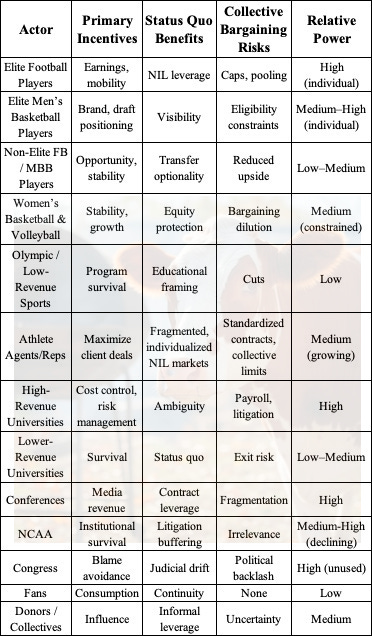
What we learn from thinking through the table above: those who would benefit most from collective stability often lack power. Those with power often benefit from legal and institutional ambiguity. Collective bargaining resolves neither problem.
Political Market Failure
The resulting stalemate reflects not a market failure in the conventional sense, but a political coordination failure under legal constraint. Congress is the only actor capable of authorizing a system-wide solution—through antitrust safe harbors, employment clarification, or authorized bargaining frameworks—but it has little incentive to do so. The political benefits of intervention are diffuse, while the costs are concentrated and highly visible, a familiar historical recipe for inaction to political scientists.
Contemporary partisan alignments do little to break this impasse. Democrats are generally more sympathetic to labor claims; Republicans more inclined to protect business autonomy. College athletics scrambles these coalitions. Athlete compensation raises equity concerns, public-sector employment questions, and culturally salient sports identities that cut across party lines. Neither party can claim clear political upside from intervention, even as pressure mounts.
As a result, the gap between what Congress could do and what it will do remains wide. At minimum, collective bargaining would require recognized employee status, a defined bargaining unit, negotiated revenue sharing, and enforceable contracts—none of which currently exist at scale in college athletics. Without congressional action to authorize or protect these arrangements, collective bargaining remains structurally out of reach.
Reform advocates, in effect, face “a long wait for a train don’t come.”
A Conditional Pivot: Collective Bargaining as a Future Stabilizer
Taken together, these changes resemble deregulation without reconstruction. Constraints were dismantled in the name of fairness and flexibility, but without replacing the stabilizing functions those constraints once served. What remains is not a freer system so much as a thinner one, more movement, less coordination, and fewer mechanisms capable of absorbing risk.
Paradoxically, the very forces that make collective bargaining difficult today may eventually make it unavoidable at least in high-revenue football. As the sport continues to professionalize, consolidate, and stratify, collective bargaining could come to be seen less as a concession to labor than as a mechanism of institutional survival: a way to trade revenue sharing for roster stability, enforceable contracts, cost control, and legitimacy.
Importantly, even this logic depends on institutional conditions that do not yet exist: meaningful separation of football from other sports, acceptance of employment status and its costs, and willingness to absorb the political and legal costs of formalization. Until those thresholds are crossed, collective bargaining remains more conceptually attractive than practically viable.
Conclusion: Collective Action Without a Collective
College athletics is not ungovernable because no one cares. It is ungovernable because the incentives shaping its most powerful actors do not align, while those who would benefit most from stability lack the power to impose it.
Nearly everyone agrees the system is strained. Proposals abound, but few agree on a fix, and fewer still are positioned to absorb the political, legal, and financial costs of enforcing one.
Athletes pursue opportunity and growth. Institutions manage legal and fiduciary risk. Conferences chase revenue. Fans continue to consume. Congress avoids ownership. Each actor behaves rationally within the incentives and constraints they face. Taken together, though, the outcome is anything but rational.
Importantly, this is not a failure of imagination or goodwill. Those working inside college athletics are, by and large, very serious and very well-intentioned people who care deeply about student-athlete welfare.
The problem is not motive; it is structure.
At the end of the day, this is collective action without a collective: a system rich in money, movement, and attention, yet structurally incapable—at least for now—of governing itself effectively.
Fascinating stuff here. I think the most important note from all of this is how little the athletes stand to gain from collective action…
Normally unions form when there is tremendous leverage on the side of management. As we see in virtually every CFB/CBB dilemma today is that elite athletes are the ones holding tremendous leverage
Really thorough political economy read. The incentive misalignment piece is what most analyses skip over. When individual exit beats collective voice, it's not athletes being short-sighted, its the system rewarding exactly that behavior. I sat in on union organizing talks back in grad school and the structrual barriers here are textbook, except amplified by Title IX and antitrust pressure that make institutional commitment nearly impossible.