

Well, fall semester is here. Every student in the US is reading syllabi with AI policies on them. Some are prohibition regimes and AI scolding. Some are “use it responsibly” that no one can actually, you know, actually measure or enforce.
I spent a chunk of the summer thinking about all of this, while also rebuilding my American Political Parties and Elections course from the studs up, and to be candid, the AI policy got too much of my thinking time.
So, um, here’s mine, as well as some thoughts and some reflections about what others, including journals, are doing.
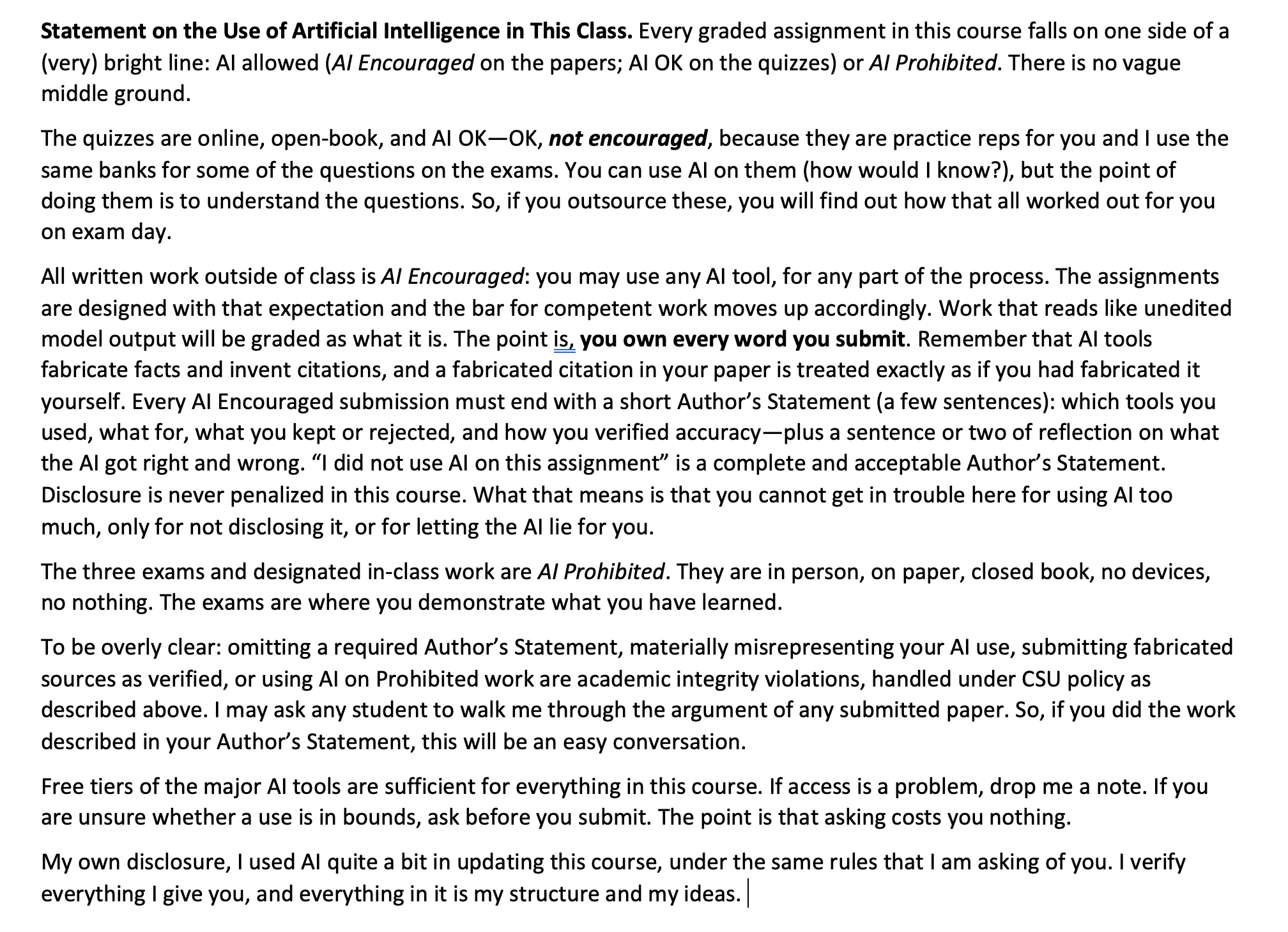
My whole statement, straight out of the syllabus:
Choosing Your Adventure
In this class, every graded assignment is either “AI allowed” (encouraged on the papers, “OK” for the online quizzes, because, well, they’re online and I can’t tell if students are using it or not) or “AI Prohibited.” There is no middle lane.
That vague middle is the problem. “You may use AI for brainstorming but not for drafting” sounds reasonable on its face, but means very little at 11pm in a dorm room. Further, what counts as brainstorming? Where does the outline stop and a draft actually start?
That line moves depending on who is asking, and I don’t think students (or anyone) should pay for that ambiguity. I’d rather draw the line somewhere I can actually defend and shine a spotlight on it so no one misses it.
A friend of mine, Ben Bishin on Facebook, pointed out that the middle ground doesn’t have to be vague; there are now tools that will generate you a precise, tiered policy. It’s a good tool and worth a look.
That said, my problem with “the middle” was never that it couldn’t be stated precisely. It’s that I can’t actually observe compliance with it. I can make a really precise rule, but if I can’t actually monitor it, it is nothing more than a well-written honor system.
The quizzes are an exemplar here: they’re online, open book, and so I labelled them AI OK. Not encouraged. OK. Because:
You can use AI on them (how would I know?), but the point of doing them is to understand the questions. So, if you outsource these, you will find out how that all worked out for you on exam day.
I can’t surveil an online quiz (my experience with Lockdown Browser has sucked). I can, however, make the quizzes worth their time, especially if I am drawing some of my questions from those same question banks. So, if you AI those, good job getting that small percentage of the course credit, and good luck on the exams.
The exams sit alone in the prohibited lane: in person, on paper, closed book, no devices, no nothing. That’s where you demonstrate what you have learned.
So, why “Encouraged” and not just “allowed”
To answer that question, I start with what prohibition actually does. It sure as heck doesn’t produce a class that isn’t using AI. It produces a class where some students are using it, quietly and undetectably, and others aren’t because they took the rule seriously. That splits the class in two, and it splits in exactly the wrong way. The students who follow the rules end up competing against invisible assistance and the efficiency gains that come with it, and their integrity functions as a handicap. That’s the kind of policy that makes no sense to me. Punishing the conscientious and rewarding the willing to chance it is a bad policy, whatever its intentions.
And sure “allowed” fixes part of that, but not all of it. Permission without endorsement, to me anyway, still carries the stench of a confessional. Students can read “you may use AI” as “you may use AI, and I will think less of your work if you do.” In response, they hedge, they use it furtively, they under-disclose.
So, the word “encouraged” is there to kill that ambiguity. This is a legitimate tool, its use is expected, and the student who leans on it hard and discloses fully is in as good a standing as the one who writes every word with a pencil.
The gains are real, and they are not evenly distributed. Some students will get an editor at their beck and call, some will use it to get unstuck, or to pressure test an argument before I ever see it. I want them to have that.
I want them to have that in a course about parties and elections of all places, since all our institutions are getting rewired by this same technology while we watch. These students are graduating into workplaces where the tools will be on the desk and others will be using them, gaining their efficiencies. I cannot in good conscience send them into that environment pretending that it’s 2019.
Leveling the field also means the whole field, not just the students who can afford the pro subscriptions. The free tiers of the major tools can do everything this course asks, and the syllabus says so. If access is a problem for you, drop me a note.
Encouragement is not without cost to them either. I make it clear that my expectations are now higher. The C paper of 2019 IS NOT the C paper of 2026.
Disclosure has to be safe, or it’s fiction
As such, I am asking for a short Author’s Statement on submissions: tools, uses, what you kept or rejected, how you verified accuracy, plus a sentence or two on what the AI got right and wrong. I don’t just want to know that a student used a tool. I want them to have noticed where it was good and where it confidently lied to them, because noticing that is the skill they are going to need in the workplace.
The statement also makes the students a promise:
Disclosure is never penalized in this course. What that means is that you cannot get in trouble here for using AI too much, only for not disclosing it, or for letting the AI lie for you.
If you want disclosure, you have to make disclosure safe. A student who suspects that admitting heavy AI use will quietly cost them half a letter grade will write you a fictional Author’s Statement, and now your disclosure regime is generating fiction.
The safe harbor isn’t me being nice. It’s the only design under which the statements have any chance of being true. (The paper itself still gets graded, to be clear. Disclosure is safe; mediocrity is not.) It’s also the playing-field logic again from up above.
The backstop (and it’s one I suspect I will need to use)…I can ask any student to walk me through the argument of any submitted paper. If you did the work described in your Author’s Statement, that’s an easy conversation.
So what is the writing for?
One pushback I’ve already gotten from my friend Tonya: if the quizzes are practice and the exams demonstrate knowledge, what are the papers assessing, exactly? Encouraging AI “for any part of the process” includes idea generation, and if the papers exist so students can communicate their own ideas, doesn’t the policy give away the thing being graded?
My answer is that I can only grade what I can actually evaluate, which is what’s on the page. The papers assess the finished analytical product: whether the argument is right, whether the evidence holds it up, whether the thing hangs together well, etc.
That means you have to vouch for it and defend it, not that every idea arrived unassisted. No idea ever does that. Students have always built ideas out of other discussions, experiences, not just what they read or heard from you. AI is just joining that list.
Meanwhile, AJPS wrote theirs
AJPS updated its AI policy on August 11, eleven days before I shipped mine. I read it expecting the usual editorial throat-clearing and found a document with the same skeleton as my syllabus page. Kudos to Berinsky and Reiter on this, btw.
Their rules for authors, in brief: AI tools are framed as “companions” to research and writing, never replacements for author judgment, and a tool cannot be listed as an author. Authors carry full responsibility for accuracy, including every citation and statistical claim the AI touched. Any AI use that shaped the research or the manuscript (text, figures, code, data work, analysis, even research design) must be disclosed in a single consolidated footnote. The disclosure is tiered: uses that shaped content get described in detail, including how much human oversight was involved, while routine writing support gets a general mention, and spell-check is exempt. Nonexistent citations get called out specifically. Failure to disclose is grounds for declining the manuscript.
Sound familiar? Accountability that never transfers to the tool. Disclosure carrying the whole regime, where the offense is hiding the use rather than the use itself. Even the hallucinated-citation clause, which both documents name explicitly, and which tells you exactly which incident everyone in academia is writing their policy in response to.
A journal and a classroom, solving for different problem sets, converged on a very similar design.
The two places we diverge
First: AJPS has no safe harbor. Nondisclosure can sink your manuscript, but nothing in the policy promises that disclosure won’t be held against you. An author deciding how candid to be in that footnote has no assurance that an editor won’t quietly discount a heavily-disclosed manuscript.
See, that is precisely the incentive problem I was trying to design out of my classroom, and I think it means journal disclosure statements will still systematically under-report, even in the face of Pangram-shaming and exclusion threats.
My students get a written guarantee. Authors get a footnote requirement and a prayer.
Second: the prohibited lanes are in different places. My course has a no-AI zone: the exams. AJPS has no prohibited lane for authors at all. Their only flat ban shows up for reviewers: a manuscript under review cannot be uploaded to an AI tool, in whole or in part.
The point is though that both allow the tools wherever the output can be verified and owned, and both ban them in the one place where a human’s own judgment is the product being delivered. My exams assess what’s in the student’s head, and they incentivize engagement with the material so that said material gets in their head.
The question underneath every AI policy fight isn’t really “how much AI is too much.” It’s “which moments in this institution exist to certify a human, and which exist to produce a verifiable thing?”
Get that sorting right and the rest of the policy mostly writes itself. Get it wrong and you end up guarding the parking lot while the vault stands open.
Then a philosophy journal ran the experiment
Philosophy & Public Affairs has had an interesting month. The journal semi-knowingly published an article written largely by an AI: the thesis and the supervision were the human author’s, most of the prose was not, and the use was disclosed in the acknowledgments. The editor called it an experiment rather than settled policy.
Within two weeks, after a discipline-wide argument, PPA had a policy, and it went the mostly opposite direction from AJPS: papers submitted to the journal must be written by their authors. Upstream uses (reading, brainstorming, critique of your drafts) aren’t policed. AI-written text is disqualifying, and an author found to have lied about it faces retraction and a ban. There’s already a sharp critique of the policy and a detailed public defense of it, and the whole exchange is worth your time.
So, yes, that looks a lot like the prohibition regime I declined to use in my classroom. You can see the reasoning in the defense: An author-written paper is a costly signal: writing it yourself demonstrates the work is yours to defend, build on, and amend, and a good paper is supposed to be evidence of the author’s talent.
The journal isn’t just accepting an artifact. It’s certifying a person, in a field where flagship publications carry hiring and tenure decisions, which makes the paper itself the credential. PPA answered the sorting question the other way: they decided the manuscript is a moment that certifies a human, not just a verifiable thing, and having sorted it that way, they banned the tools. Same move I make with my exams, just in a different building.
Three different regimes, then: encouragement in my classroom, disclosure at AJPS, prohibition at PPA. They disagree about nearly everything except the architecture, and each one draws its no-AI line around whatever it takes itself to be certifying a human, then lets the tools in everywhere else.
The difference I’d flag is enforcement: my no-AI room is proctored, and PPA’s isn’t. Their regime holds only as long as AI-written text stays reliably detectable after the fact, and that’s a bet I wouldn’t take, not even at even odds.
And sure, this too could go sideways
The walk-through-your-argument backstop works in a course where I can actually schedule those conversations. It does not scale to a big intro class. And the higher bar is basically betting that my assignments can stay ahead of the tools and the tools are not standing still. “Graded as what it is” requires me to recognize unedited model output usefully. I won’t catch every single thing, but it does set the incentives in the right direction. Under my rules, a paper written largely by AI, fully disclosed, verified, and defended, earns whatever grade the paper earns.
I take very seriously the objection from the prohibition camp, which goes something like: writing is thinking, and a policy that encourages AI on every paper is betting that students will reflect and iterate and think through what they’re doing. Maybe they won’t! Maybe the Author’s Statement I ask for just documents the hollowing of minds instead of preventing it. My answer to that is the exams (55% of my course, while writing is now only 25% total). Nowhere to hide there, but we’ll see.
So, that’s where I landed. Ask me in late December how I feel about these choices. Maybe I am making the wrong ones, but as of today, they make sense in my head.
If you know someone drafting their own AI policy this week, restack this and save them a weekend…because this took me months. :)
The syllabus rebuild that produced this policy also ran on a lot of coffee. You can contribute to the next one here.
And yes, AI was used to help me iterate this piece, which allowed me to get it done in a few hours (I started working on this last night, but then I posted my AI policy this morning on Facebook, got some feedback and adapted…). That said, I am disclosing that these are my ideas, thoughts, and structure, but it helped me with edits and it caught some things (like faulty logic and argument) that I didn’t, just as I do in my Substack AI statement.
If there is a chance that AI will touch their references, then they need an AI-free automated reference checker. Here's one: https://www.refrunner.com/
This is very good, and similar to what I am doing in my two classes (mine is a bit simpler). I might do a post on this later, linking to yours.