
The Eternal Wheel
Polybius’ Warning, Cycles of Power, and Why History’s Patterns Aren’t Destiny

In moments of political anxiety, cyclical theories of history surge in popularity. They promise intelligibility amid chaos, as well as some reassurance that what feels unprecedented is, in fact, patterned. When institutions get wobbly, the appeal of the “wheel” is obvious. If decline follows a recognizable arc, perhaps it can be anticipated, or even managed.
A recent post on X by historian M. F. Khan resurfaced one of the oldest and most enduring versions of this impulse: Polybius’ theory of anacyclosis, the cycle of political regimes. The graphic accompanying the post, which is a smooth wave tracing monarchy, aristocracy, democracy, and their corrupted counterparts, felt uncannily contemporary.
But Polybius’ relevance does not lie in prediction. His value is diagnostic. Anacyclosis is not a law of motion; instead, it is a map of recurring failure modes. Polybius was not claiming that governments collapse because they reach a particular point on a wheel. He was arguing that political and social orders tend to break down in recognizable ways when institutions lose the capacity to mediate conflict.
That distinction matters, especially in these “liminal” (goodness, I am so tired of that word, aren’t you?) days.
Polybius and the Grammar of Political Failure
Writing in the second century BCE, Polybius observed that regimes tend to move through six forms of rule: monarchy, tyranny, aristocracy, oligarchy, democracy, and ochlocracy (mob rule). The sequence is familiar, but what is often missed is why the transitions occur.
Each regime fails for identifiable reasons:
Monarchy decays into tyranny when authority detaches from accountability.
Aristocracy slides into oligarchy when selection gives way to self-protection.
Democracy collapses into ochlocracy when freedom dissolves into license and political judgment yields to passion and demagoguery.
So, what repeats is not the sequence itself, but vulnerabilities. Different societies enter the cycle at different points, stall in different places, and exit through different mechanisms. Polybius was just cataloging institutional stress points, not predicting a timetable.
Rome mattered to Polybius because of its composite constitution: consuls embodied monarchical authority, the senate aristocratic counsel, and assemblies democratic agency. This setup institutionalized competition, checking any one element from dominating. For Polybius, this balance did not eliminate conflict but channeled it into structured rivalry, slowing the rapid decay seen in purer regimes and helping sustain stability over time. His discussion of the Roman constitution deeply influenced later thinkers about balanced government; classical commentators and Enlightenment figures such as Montesquieu drew on the idea of mixed regimes, and that tradition informed the Founders’ understanding of checks and balances in the American constitutional system. James Madison’s concern in Federalist No. 10 with reconciling competing interests—“factions”—within a large republic reflects this broader classical logic of balancing powers rather than concentrating them.
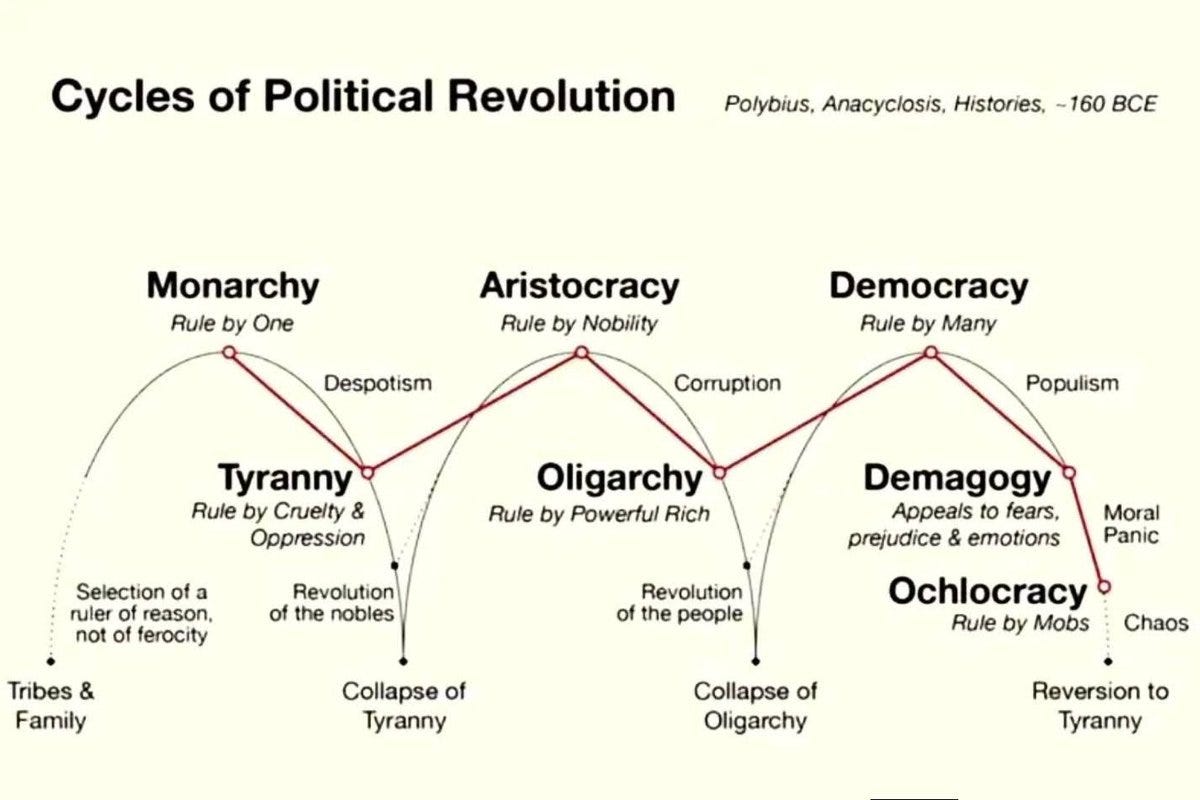
The diagram is heuristic, not predictive. Polybius was mapping tendencies in how authority decays, not claiming a mechanical sequence or fixed timing.
Cycles, Mechanisms, and the Dalio Problem
Any contemporary discussion of historical cycles carries a lot of baggage. Over the past decade, cyclical explanations have been popularized—perhaps most visibly by Ray Dalio—as quasi-laws of rise and decline. These accounts blend real historical regularities with smooth curves, stylized phases, and retrospective coherence.
Critics are right to be skeptical.
The best objection to cycles is simple: societies don’t collapse just because they’ve hit a phase on a wheel. They collapse because specific institutional capacities fail under specific pressures. When cycles are treated as causal forces rather than descriptive summaries, they obscure more than they reveal.
But rejecting crude cyclical determinism does not require abandoning the insight that political breakdown tends to recur in structured ways. The question is not whether history moves in circles. The question is whether certain combinations of inequality, elite competition, fiscal strain, and legitimacy loss reliably push systems toward instability.
On that narrower claim, Polybius survives the Dalio critique. He was not selling inevitability. He was offering a grammar for recognizing when political orders begin to rot.
One reason cyclical theories feel newly persuasive is that the speed of contemporary technological change is colliding with institutional designs built for slower worlds. Modern political institutions evolved to arbitrate disputes, process evidence, and legitimate authority under conditions of informational scarcity and temporal lag. Artificial intelligence breaks those assumptions. It accelerates decision-making, compresses feedback loops, and multiplies the volume of plausible claims faster than institutions can evaluate or referee them.
So, the real problem is not necessarily that machines are becoming smarter than us (though that definitely is going to change a lot!). It is institutions just handing decisions to systems because they no longer trust themselves to decide. Algorithms promise speed, consistency, and neutrality at moments when human judgment has become slow, contested, and politically costly. But this does not resolve conflict, it sidesteps it. In Polybius’ terms, nothing fundamentally new is happening. Authority is drifting away from judgment, and legitimacy is being replaced by procedure. What looks like a technological break is better understood as an institutional stress test—one that accelerates failures Polybius thought were all too familiar.
(I develop this argument at greater length in an earlier essay on AI as an institutional stress test, rather than a solution: AI Won’t Fix Our Epistemic Problems, It Just Reveals Them.)
Generational Rhythm: Where Strauss and Howe Help—and Where They Don’t
In the 1990s, William Strauss and Neil Howe proposed their theory of generational cycles in The Fourth Turning. History, they argued, unfolds in roughly 80- to 100-year “saecula,” each divided into four phases: High, Awakening, Unraveling, and Crisis.
The appeal of the framework is obvious. It captures how crises feel: moral urgency, institutional exhaustion, generational conflict, and a sense that ordinary politics no longer works. Strauss and Howe explicitly situate themselves in a long tradition of cyclical thinking, drawing on Polybius and Ibn Khaldun.
The weakness of the Fourth Turning is not its attention to rhythm. It is its tendency to smuggle narrative coherence where institutional analysis would be more precise. The theory excels at describing cultural mood, but it often blurs the mechanisms that make those moods dangerous.
Where Polybius asked how regimes fail, Strauss and Howe attempt to tell us how crises are experienced.
There is also a temptation, here, to take Strauss and Howe more literally than they deserve. As a member of their so-called “Nomad” generation—Generation X—I can attest to at least one part of the typology: we do, in fact, spend a great deal of time nomadding. We were socialized inside the post-World War II institutional order without ever fully believing in it, and now find ourselves shuttling uneasily between that fading settlement and whatever hell this is that’s coming next.
If there’s a grain of truth here, it’s not generational destiny—it’s that some cohorts are positioned to handle decline and drift, not renewal. Nomads do not build golden ages. We jury-rig systems long enough for someone else to rebuild them—or dismantle them entirely.
Cliodynamics: When Cycles Become Constraints
That gap is where Peter Turchin enters. Turchin’s structural-demographic theory treats societies as systems with interacting components: population dynamics, elite competition, and state capacity. Instability emerges not from generational destiny, but from pressure points—most notably elite overproduction, declining real wages, and fiscal stress.
In Ages of Discord, Turchin applies this framework to U.S. history, identifying recurrent spikes in political violence and instability roughly every fifty years. The causes differ—labor conflict in the late 19th century, racial and ideological violence in the early 20th, protest and unrest in the 1960s–70s—but the structural pattern is consistent.
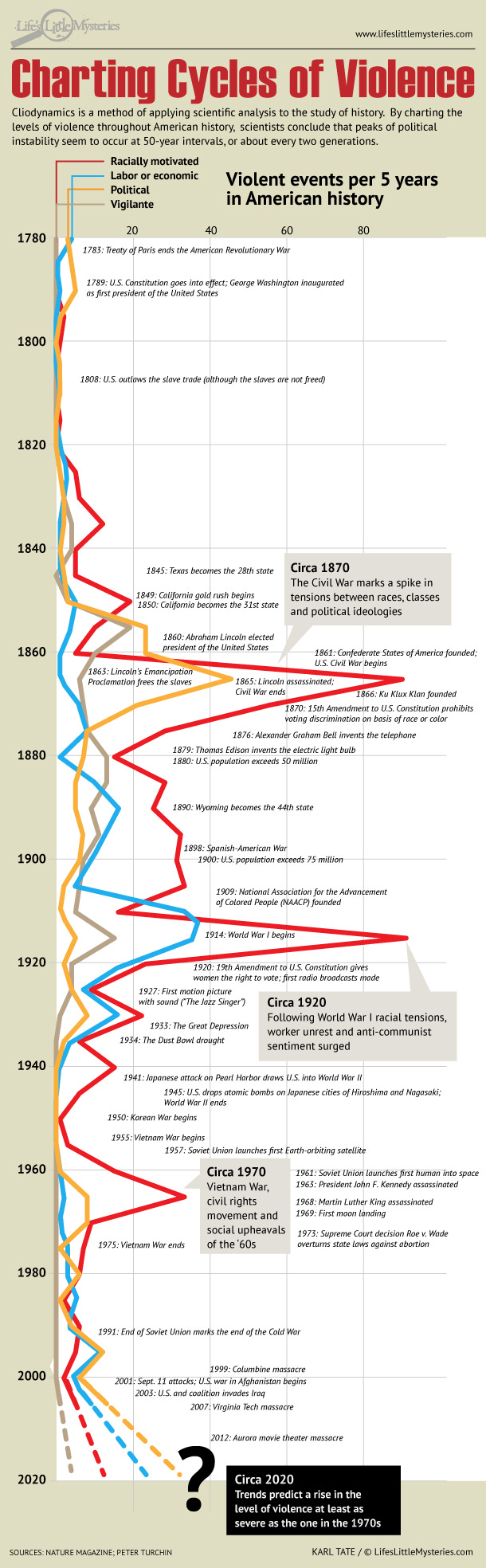
What recurs is not ideology, but stress on institutional mediation—periods when conflict spills outside normal political channels.
Turchin’s contribution is not prophecy. It is constraint. His models do not say collapse is inevitable. They show when systems become fragile—when small shocks produce outsized effects because buffers have eroded.
In Polybian terms, elite overproduction mirrors the functional slide from aristocracy to oligarchy: when selection gives way to hoarding, legitimacy thins and conflict sharpens.
Older Than Rome: Ibn Khaldun and the Erosion of Solidarity
Centuries before Polybius, Ibn Khaldun offered a structurally similar account of political rise and decay in The Muqaddimah. His central concept, asabiyyah—often translated as group solidarity or social cohesion—described the binding force that enables collective action, sacrifice, and political authority. For Ibn Khaldun, strong regimes do not emerge from material wealth or administrative sophistication alone, but from dense social bonds that generate loyalty and discipline.
In his account, cohesive nomadic groups repeatedly conquer wealthier, more complex societies not because they are technologically superior, but because they retain stronger internal obligation. Over time, however, success undermines the very solidarity that made conquest possible. Luxury dulls discipline. Privilege replaces duty. Authority becomes inherited rather than earned. As asabiyyah erodes, the state grows dependent on coercion and patronage rather than shared commitment.
The parallel with Polybius is not merely thematic but structural. Both thinkers locate political failure in the same place: the separation of authority from obligation. Institutions are strongest when power is constrained by shared norms and mutual dependence. They weaken when rule persists without reciprocity—when obedience is expected but no longer meaningfully justified. What Ibn Khaldun adds is an explicit account of how prosperity itself can corrode the social foundations of legitimacy.
Complexity and Collapse
A different but complementary strand comes from Joseph Tainter, whose theory of diminishing returns reframes collapse not as moral decay or external invasion, but as a problem of systemic overload. Societies, Tainter argues, respond to challenges by adding complexity: more bureaucracy, greater specialization, denser regulation, and layered administrative structures. Initially, these investments pay off. Problems are managed. Stability improves.
Over time, however, the returns on added complexity decline. Each new layer solves a narrower problem at higher cost. Eventually, societies reach a point where maintaining complexity consumes more resources—economic, cognitive, political—than it delivers in benefits. At that point, systems become brittle. Shocks that would once have been absorbed now cascade. Collapse follows not from barbarism or ignorance, but from an inability to sustain the institutional weight of prior solutions.
Tainter’s insight dovetails cleanly with Polybius and Turchin. Oligarchy is expensive. Elite competition multiplies administrative demands. Complexity becomes a substitute for legitimacy rather than a support for it. When institutions grow elaborate but lose public trust, they cannot simplify without losing control—and cannot expand without accelerating exhaustion. Fragility emerges not because societies fail to solve problems, but because they solve too many of them in ways that outstrip their capacity to maintain coherence.
What the Wheel Really Warns Us About
None of these frameworks imply inevitability.
What they do imply is constraint. Societies do not choose freely among infinite futures; they choose within narrowing institutional and demographic conditions.
Collapse is not destiny, but neither is stability. The danger of cyclical thinking is fatalism. The danger of rejecting it entirely is complacency.
Polybius’ warning was not that republics must fall, but that they fail in recognizable ways when institutions lose the capacity to mediate conflict without personalization, moral absolutism, or violence. The wheel spins fastest when referees stop functioning.
So, the question facing contemporary democracies is not whether history is repeating. It is whether we still possess the institutional capacity to interrupt its most common failure modes—before passion substitutes for judgment and power detaches from constraint.
History does not demand repetition.
But it sure does punish denial of reality, and reality always bats last.
Selected Sources
Polybius, The Histories, Book VI (public domain translation):
https://penelope.uchicago.edu/Thayer/E/Roman/Texts/Polybius/6*.htmlStrauss, William, and Neil Howe. The Fourth Turning. Broadway Books, 1997.
https://www.penguinrandomhouse.com/books/293853/the-fourth-turning-by-william-strauss-and-neil-howe/Howe, Neil. The Fourth Turning Is Here. Simon & Schuster, 2023.
https://www.simonandschuster.com/books/The-Fourth-Turning-Is-Here/Neil-Howe/9781982173746Turchin, Peter. Ages of Discord. Beresta Books, 2016.
https://peterturchin.com/book/ages-of-discordTurchin, Peter. “An Intermediate Retrospective on Ages of Discord.”
https://peterturchin.com/an-intermediate-retrospective-on-ages-of-discord/Ibn Khaldun, The Muqaddimah (Rosenthal translation):
https://www.princeton.edu/~ibnkhldun/Tainter, Joseph. The Collapse of Complex Societies. Cambridge University Press, 1988.
https://www.cambridge.org/core/books/collapse-of-complex-societies/1B6BEBE0F6D8A64A8E1A0D48A4F6B5C