
Imagine a World Without Rice
The Protect College Sports Act cleared committee by promising to save everyone but the giants. Read the text it actually passed, and what it builds is a fence.

Sen. Ted Cruz spent part of Thursday afternoon imagining a world without Rice football.
The Senate Commerce Committee had just voted his Protect College Sports Act out, 19 to 9, and Cruz reached for the stakes. “I love Texas and A&M, but they are going to thrive and win national championships. If we don’t act, I’m not sure any other Texas program survives. I look around Texas and imagine a world without TCU, SMU or Baylor or Texas Tech or Houston or Rice.” Sen. Maria Cantwell sells it the same way from the other side of the aisle, except her example is Washington State, the school her state watched get left behind when the Pac-12 came apart. Two sponsors, one pitch: this bill saves the programs that aren’t the superpowers.
The pitch is a good one, and parts of it are true. But it’s worth taking a moment to reflect on what “save” means in the text that actually passed, because the bill the committee reported doesn’t rescue the schools below the top so much as fix them in place.
Before we get to that, though, I owe you a grade, because Tuesday I told you what to watch and a week before that I put nine predictions on a public scorecard precisely so I couldn’t weasel later. So let’s settle up.
How the map held up
The targeting memo named five gettable Democrats on Commerce by luck of the roster (Sens. Markey, Rosen, Luján, and Hickenlooper, with Schatz just under the line), but I predicted no more than two would vote yes.
My bet wasn’t really about the number, it was more that party discipline would freeze most of the Ds on the committee from supporting. But four came along: Rosen, Luján, Hickenlooper, and Schatz all voted aye, and only Markey held out from that pool of non-power-school-heavy Ds.
So the scorecard takes a miss, but I did get the candidate pool right! That said, the idea that the whip would freeze the caucus even at this stage (which will be stronger if/when this thing sees the floor) is the thing that failed.
The map did better on the Republican side. It flagged Blackburn, Wicker, and Young as the cross-pressured tail likeliest to balk; Blackburn surprisingly stayed in line, but Wicker and Young, the SEC and Big Ten's men on Commerce, turned out to be the only two Republicans who voted no. I'd marked them as the risk rather than called the no votes outright, but the read pointed at the right tail.
What I got wrong was the size of the Democratic yes. Why? For weeks I’d been writing that the bill kept getting dragged rightward, toward the NCAA’s and the SEC’s asks, and that rightward is where the votes aren’t. The memo I did laid out three ways the markup could lurch, and said flatly that only one of them, the build-left, was the one that had sixty votes in it, while also being the hardest for a Republican chairman to actually execute.
Well, Cruz executed it.
He left Sen. Bernie Moreno’s athletes-aren’t-employees-and-no-trans-women amendment out of the package entirely, the one pill guaranteed to cost him every Democrat in the room. He took Sen. Tammy Duckworth’s swing at lifting the revenue-share cap and sanded it down to a one-word transfer tweak. He paid the gettable Democrats in small, legible coin: two more mid-sized-conference seats on the bill’s new commission, a higher floor on the catastrophic-injury fund, a narrow cap on coaching pay. And he held the two things the SEC and Big Ten most wanted gone, and required for D support, the media-rights pooling and the rebranded ban on a breakaway super league. That’s the build-left road the memo said was the only one with sixty in it. Cruz walked it on the record, and six Democrats walked through with him.
So the bill is reported out. It is still a disjointed Frankensteinian mess. But it has a little more D support (for now) than I expected. The path to the floor exists. That said, if you read what came out of that room, the rescue starts to look like something else.
The fence
Start with the provision the two giants hate most, because it’s the least ambiguous. The bill bolts a new section onto the old Sports Broadcasting Act and titles it, with no euphemism, “Prohibition on Certain Conference Mergers and Acquisitions.” A conference pulling in more than seven hundred million dollars a year, which now means all four power leagues after the trigger dropped from a billion, can’t merge with another conference, or buy up its members, its media rights, or an independent like Notre Dame. Do it anyway and the transaction is void, with no antitrust defense allowed. The SEC and Big Ten read that correctly as a cage. It bars the breakaway super league they’ve been quietly modeling, the exit I walked through this spring.
The ban is bolted to the giants’ side of the table: the seven-hundred-million-dollar conferences are the ones that can’t merge, can’t acquire, can’t absorb. And the binding is total. For example, the Big 12 can’t merge with another power league, can’t swallow the rebuilt Pac-12 as a bloc, can’t take in an independent like Notre Dame, and can’t even pluck a single school loose, because the act the statute forbids is a covered conference acquiring “the membership of another covered conference or of an independent institution,” and adding one school is acquiring exactly that. Note that last clause: an independent has no membership to buy, so “acquire the membership of” can only mean “take into membership,” which is the lawyer’s way of saying “add.” In this example, the Big 12 is the bound party, and the bound party is locked down.
So the old staircase isn’t just murky. It’s gone. A school used to be able to rise out of the G5 the way Utah and TCU did, by getting invited up into a power league; that invitation is now illegal to extend. The institutional power rosters freeze exactly as they sit the day this becomes law. The leagues below can combine with each other all they want, two have-nots stapling their inventory together, but they can’t assemble anything a power conference is allowed to absorb, and the market math that decides who’s worth a real television contract the bill leaves exactly where it found it. The wall doesn’t name the climbers. It just bolts shut the only door they had.
The bill then adds two more walls of its own.
The first is the lifeline itself. Pooling media rights is the mechanism Cantwell points to when she explains how the bill helps a Washington State: pool the inventory, sell it together, claw back some of what realignment stripped out. Except the committee adopted an amendment shielding existing television contracts from the pooling exemption, which means no pooled rights until those deals run out, somewhere around 2031. The rescue is real on paper and five years away in practice. The schools it’s pitched to are running deficits now.
The second is Sen. Luján’s amendment with the eighty-million-dollar line, and that’s where the fence grows a few teeth. Cross it and two things switch on. Your department has to hold its women’s and Olympic rosters at last year’s levels, which is the sympathetic, camera-ready half. And under Luján’s idea, you can no longer pay a coach more than five hundred thousand dollars out of non-athletic money. Every dollar above that has to come from athletic revenue or donations, not from the university’s general fund.
The giants are not going to feel this much. They generate so much revenue that they don’t reach into the institutional till to pay a coach. The schools that do reach into it are the strivers who can’t yet cover a competitive staff out of athletics alone, the ones leaning on the university to bridge the gap while they try to grow into the tier above. So a rule that reads like a cap on the rich is aimed, in practice, at the strivers.
I went and put the public numbers against the line, using my own athletics-finance map. Six non-power programs are already over eighty million using 24-25 data: UConn, South Florida, Oregon State, San Diego State, Boise State, and Washington State. Add a year of the revenue growth the rev-share scramble is pushing everyone to chase, and the line catches a cluster more, Memphis and James Madison and Utah State sitting a normal bump below it. Not all of them will get there; some are fighting to hold revenue rather than grow it. But the line sits right where the ambition is. The giants cleared it so long ago they never think about it; the schools bunched up against it are the ones still trying to climb past.
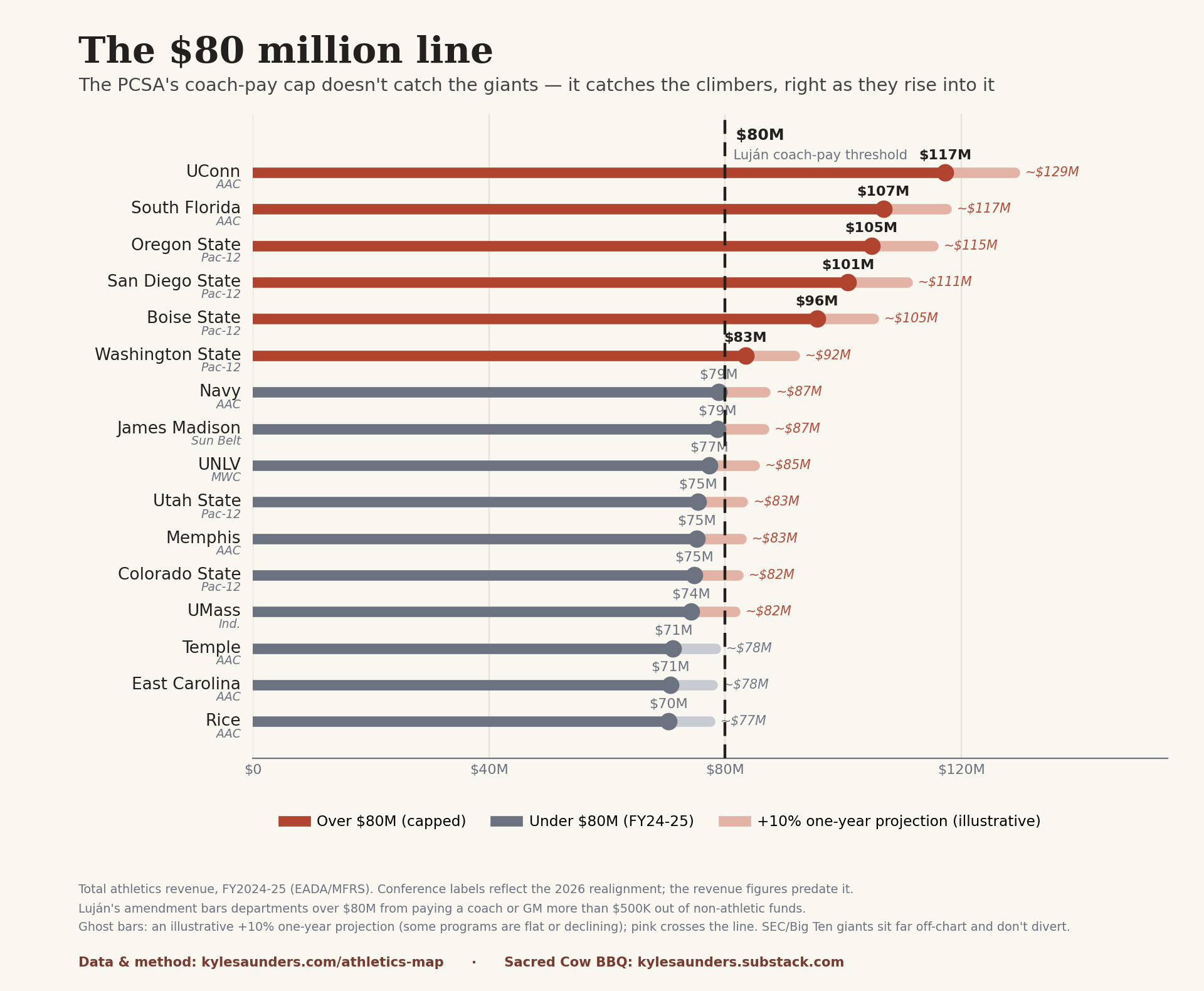
Take Boise State as an example, since it’s as clean a case as I can present. A program that made the twelve-team Playoff in 2024, with a national brand and a traveling fan base, sits around ninety-six million dollars on the public books. Over the line. Capped on what it can spend to chase the staff that gets it to the next tier, barred by the merger ban from consolidating its conference up into the room where the real money is, and waiting on a pooled-rights lifeline that doesn’t arrive until 2031.
Underneath all of it sits the House settlement, the antitrust deal that set up revenue sharing last summer. The bill doesn’t replace it. It welds it in. The revenue-share cap isn’t a figure Congress chose; it’s the settlement’s “Benefits Pool Limit,” incorporated by reference, and a later section keeps it running, CPI-adjusted, after the settlement itself expires. A private, ten-year, court-supervised truce becomes open-ended federal law, carried past its own expiration date, with the antitrust immunity the settlement could never grant itself.
Which brings us back to Cruz’s world without Rice. He isn’t wrong that the unfenced version of college sports is brutal for the schools below the top. That world is the one that dismembered the Pac-12, where the strong poach the weak and call it the market. A Washington State or a Boise looks at that and reasonably prefers rules, any rules, to being eaten.
So the pitch lands. And yes, the bill really does protect those schools from annihilation, or from being stranded below a breakaway. It just does so by pouring concrete around the hierarchy as it stands today, with them on the outside of the top of it. Stability and foreclosure turn out to be the same provision, read from two directions.
That’s not hypocrisy on anyone’s part, and this series keeps insisting on the distinction—yes, I know I get redundant about this sometimes, but it’s a very important point.
Mancur Olson, patron saint of this here barbecue, wrote the book on how arrangements like this one calcify: the interests already organized around the money lock in their share, and once a law ratifies that lock, the structure stops being negotiable. The settlement was the bargain. The bill is the weld.
The schools Cruz and Cantwell keep naming to sell it weren’t party to that bargain. The table was set a tier above them.
What still stands between this and law
All of which describes the reported bill, and the reported bill is not a law. It cleared one committee. It still has to cross the Senate floor, where it needs sixty votes to break a filibuster, and no, before anyone asks, this isn’t the kind of bill that gets the fifty-one-vote budget shortcut. It’s ordinary legislation moving through regular order, so the sixty-vote wall is real. Predictions six, eight, and nine on that scorecard, the ones about a sunset clause and standalone passage and a must-pass attachment, are all still live.
Clearing committee is the cheap part of the floor problem anyway. A bill doesn’t reach a Senate vote on merit; it reaches one when the majority leader puts it there, which means Majority Leader John Thune has to decide college sports is worth burning important floor days on in an election year. If he does, the likely sequence is a fresh leadership substitute that folds in whatever got cut in the interim, a cloture vote at sixty, then a run of floor amendments, any one of which can be built to peel off a vote the sponsors are counting on. Survive that and the bill still meets the House, and then the two chambers have to reconcile their texts into one, on the same closing calendar. The memo’s bottom line holds: the content barely drives the math. What drives it is whether the regime lets anyone go collect the votes. Thune controls whether it gets floor time and a real whip from his side. Minority Leader Chuck Schumer controls whether the caucus is told to treat a yes as handing President Trump a win. And the blessing from Trump has to land loud enough to hold the Republican right, quiet enough not to stamp the whole thing partisan, the needle nobody has reliably threaded.
The calendar may settle it before any of that does. On the day of the markup, Puck’s John Ourand reported that nothing moves before November. “The Senate doesn’t have the bandwidth to do this right now,” a Hill source told him, “let alone a controversial bill like this.” The session has thirty-nine days left in it, and if the bill doesn’t clear before Election Day, a reshuffled Congress sends the whole thing back to square one.
If you want the board underneath all that, the memo still has it, senator by senator: the home-state athletics money for the bill and against it, charted separately so the in-state fights don’t wash out; each senator’s ideology from the full voting record; and who’s actually exposed in November. This post is what the text builds. That one is who votes for it, and what they cost.
And the two most powerful conferences are now fighting this out in the open. Their presidents put out a joint statement complaining they got “a single 30-minute call” in which Cruz and Cantwell did most of the talking, and that most of their recommendations never made the revised text. Greg Sankey is litigating the point on X. The bill that cleared committee still isn’t final, and the two richest leagues in the sport are pressing to reshape it before it reaches the floor, which tells you how badly the sponsors want their votes, or at least their silence.
The House is its own wall, and it is a higher one. The companion bill there hasn’t had a hearing and likely won’t until this moves in the upper chamber. It sits referred to three separate committees, each with a jurisdictional claim, sponsored by the Spokane Republican who fought alongside Cantwell against last year’s version. Three committees is three sets of veto points the Senate’s single path never had.
Remember, I said that the realistic route to law for a bill like this was never a clean standalone vote anyway. Instead, it’s getting stapled to something must-pass at the end of a session, which is a December event, not a June one, and which forfeits the standalone win everyone here is spending political treasure to claim.
The opposition isn’t only the giants, either. Ten players’ unions, under the AFL-CIO, came out against the bill the morning of the markup, even as the committee’s own press release still listed two of them as supporters. Athletes.org, the advocacy group that’s the closest thing college players have to their own union, came out against it the same morning. The bill is studiously neutral on whether athletes are employees, which is the whole fight for the labor side: a cap, and no seat at the table to bargain over it. Bomani Jones spent a segment Thursday calling it what the left sees, a bill that caps the workers and tells them to be grateful. The coalition holding this thing together wants it for opposite reasons, which is the same fragility the memo flagged, now louder.
And the fix that might actually settle this is the one the bill steps around. The morning after the markup, Tennessee’s athletic director, Danny White, made the case that athletes could bargain through a single national employer without ever becoming employees of their own schools, and Mit Winter called collective bargaining “the only viable long term solution for college athletics.” It’s a heavy lift, as Darren Heitner pointed out: you’d have to define the bargaining units, establish the employer, organize the unions, elect the leadership. But the difficulty is an important signal. A cap with no table is the easier thing to pass, and the easier thing to pass is the one that doesn’t resolve what everyone is actually fighting about.
So what did Thursday actually settle
Much less than the 19-9 headline suggests and a little more than I’d have guessed a week ago.
It settled that the build-the-PCSA-left road existed and a Republican chairman will take it, and I’ll admit that I doubted Cruz had that in him.
It settled that, for now, the gettable Democrats will get on board when the price is a commission seat instead of a labor concession, which I also doubted.
Cruz and Cantwell found their coalition. That said, the math, the sixty-vote floor and the House and the calendar, is all still sitting there exactly where it was. Maybe it’s increased the likelihood of this thing getting through to 15-20%. Maybe.
Still, the fence got built in committee regardless, in the text, with six Democratic votes and a speech about saving Rice. That part doesn’t depend on the floor at all. A sport that spent three years losing in court has reached for stability the way you grab a railing on a pitching deck, and the bill hands it over. The price is mobility, charged mostly to the schools still doing the climbing. Maybe that’s a trade they’d take with their eyes open, since a frozen ladder still beats the free-for-all that ate the Pac-12.
But it’s a trade dressed as a rescue. Whether or not the Senate ever passes it, the programs Cruz keeps naming as the reason for the bill are the ones it walls out, and they already know which it is.
New to Sacred Cow BBQ? I run the week’s college sports news through a political-economy lens. Subscribe and the next one lands in your inbox.
The comments are open, and the scorecard is public, misses and all.
Catch up on the series: Watch What They Reach For, The PCSA Political Consulting Memo Nobody Commissioned, The Sorsby Ruling Proves the Point, Be Careful What You Lobby For, The Borrowed Authority of College Athletics, and the flagship, How Collective Bargaining Could Stabilize College Football.
NB: Written in my capacity as a political scientist who studies institutions, incentives, and collective action, not as an institutional spokesperson

.