
The Credential Is the (Democratic) Coalition
Part 5 in the AI and Politics series

A friend and colleague of mine recently invited a high-level state Democrat to speak to his class about campaign operations. The official walked the students through voter database management, field organizing, micro-targeting — standard stuff. At one point she paused and said, unprompted, that all of this work was done by humans. Not AI. People.
She wasn’t answering a question. Nobody had asked. She just felt the need to say it — to reassure a room full of university students that the Democratic Party wasn’t using the technology that, by every practical measure, would make the work she was describing faster and cheaper.
I’ve been chewing on that moment since I heard about it. Not because it tells us anything about Democratic technology adoption — it doesn’t, really. But because it tells us something about what AI has become inside the Democratic coalition. It’s not a policy question. It’s not even an economic question, exactly. It’s a thing you distance yourself from. A thing you reassure people about. A tribal marker.
And I think the reason it’s become that — the reason Democratic anti-AI sentiment is so intense and fast-moving compared to what’s happening on the Republican side — goes back to something that happened before AI arrived.
The Cleavage Rotated
Bear with me for a minute, because I need to go back to 2016. Actually, further than that.
My friend Jennifer Victor — along with my friend, the late Scott McClurg — published a piece back in 2016 building on Miller and Schofield’s work on partisan realignment. They mapped it on a simple two-dimensional chart that I keep coming back to. I redrew the cleavage line after the 2024 election (and yes, some of those names are dated (Pete Freaking Wilson!) and for you younger people you may have no idea who they are, and yes, I’ve been meaning to redraw this, but I haven’t yet) and the picture it paints is striking. Put the economic dimension on the horizontal axis — left to right, redistributive to free-market. Put the social dimension on the vertical — liberal at the top, conservative at the bottom. Now draw the line that best separates the two party coalitions.
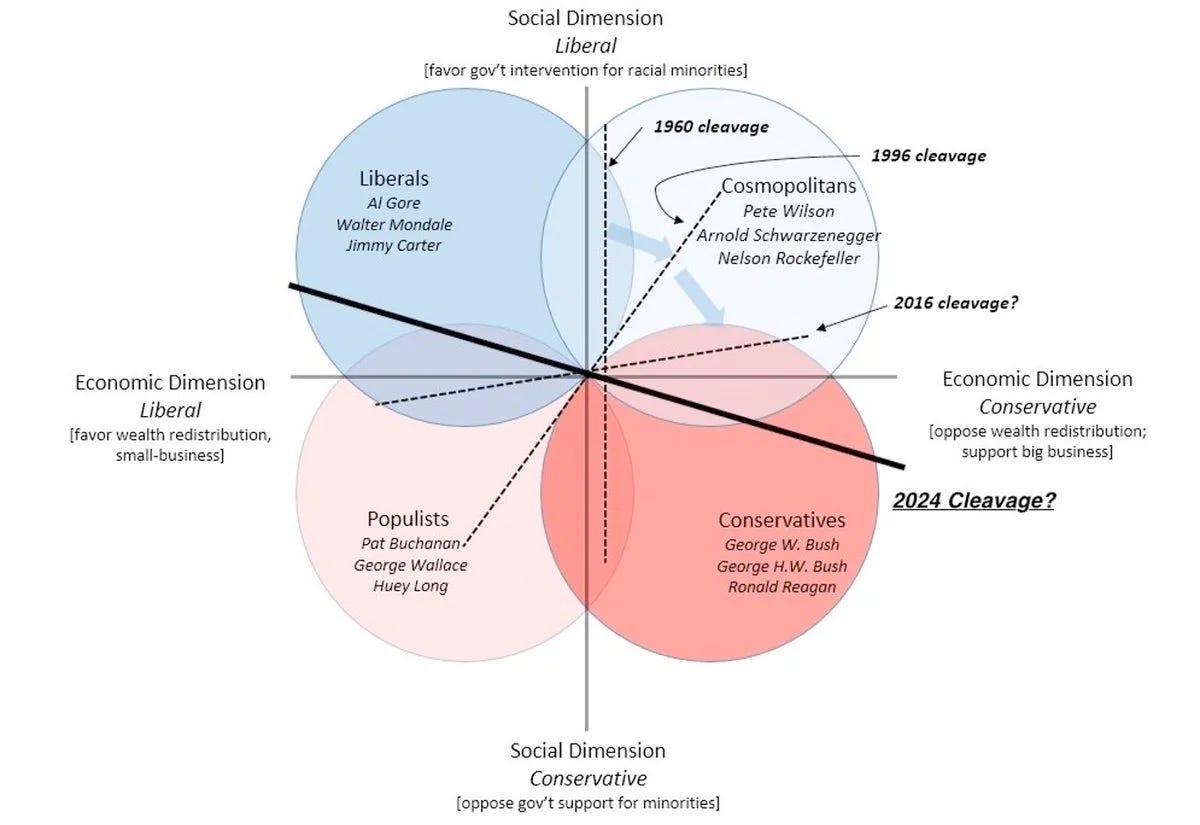
In 1960, that line was nearly vertical. The dominant cleavage was economic. New Deal politics. Labor versus capital. You could be socially conservative and vote Democratic if your economic interests pointed that way, and plenty of people did.
By 1996, the line had started rotating. Culture was entering the equation — religious right activism, the post-Reagan coalition. But economics still mattered a lot. And, it was really “conservatives versus liberals.” (Note, dear reader, this is when I started writing with Abramowitz about polarization and ideological realignment and all that jazz.)
By 2016, the line had rotated further, almost becoming the x-axis, separating the upper from the lower (aligning the liberals with the cosmopolitans on one side, and the populists and the conservatives on the other). That meant the working cleavage was the cosmopolitan, socially liberal, economically left-of-center versus the populist, socially conservative, economically skeptical of redistribution folks.
And by 2024? I argue that the cleavage divides almost completely the cosmopolitans from the populists. Not old school left and right. Not liberal to conservative. Cosmopolitan vs. populist. And the single strongest predictor of where you fall on that line isn’t income, isn’t race, isn’t religion — though all of those matter. It’s education.
Now — this line doesn’t perfectly sort within the parties, and that matters. The Democratic coalition still has a left-populist wing — the Sanders constituency, working-class Democrats, the people whose politics are populist but who ended up on the cosmopolitan side of the partisan divide anyway. They’re Democrats, but they were never credentialed-class Democrats. They didn’t sort into the coalition because of the credential. Keep that in the back of your mind, because it’s going to matter when we get to why the AI fracture is (gonna be and already is kinda) so messy — the credentialed wing and the left-populist wing are both anti-AI, but for completely different reasons.
Still, this is the realignment that preceded all this AI stuff. And you can’t understand what AI is doing to American politics without understanding what that realignment did first.
Education Became Everything
Here’s what happened, stripped to its bones.
Over the past three decades, education overtook income as the strongest predictor of partisan identification. College-educated voters — especially those with graduate degrees — sorted into the Democratic coalition. Non-college voters sorted into the Republican coalition. This happened gradually, then suddenly, and by 2020 it was the single most powerful demographic cleavage in American electoral politics.
But education wasn’t just predicting who people voted for. It was predicting something deeper about how they related to institutions, authority, and complexity itself.
The college credential was obviously an economic asset — the degree opened career doors, certified cognitive skills, delivered a measurable earnings premium. Everyone knows that part. But it was also doing something sneakier. Because the educated professional class wasn’t just earning more. It was sorting into Democratic institutions, Democratic social networks, Democratic cultural spaces. The credential was becoming a political identity marker.
And here’s where I keep going back and forth on how strong to make this claim, but I think it holds: the credential was also functioning as an epistemic orientation. A comfort with abstraction. A trust in mediated institutions. An acceptance of procedural complexity and bureaucracy. The kind of people who got graduate degrees were, increasingly, the kind of people who believed the system worked — or at least that working within the system was the right approach.
I’m not sure those three functions were ever cleanly separable. They fused. The credential wasn’t just a ticket to a good job. It was a ticket into a worldview and a political home.
Now, I’m not saying education caused people to become Democrats in some simple mechanistic way. The sorting was bidirectional and culturally thick. But by the time the dust settled, the professional credentialed class was the load-bearing wall of the Democratic coalition. Not the only wall. But the one carrying the most structural weight — in fundraising, in institutional staffing, in media production, in the knowledge infrastructure that shaped how the party understood itself and its mission.
Then AI Comes Walking In
OK, so you’ve got this coalition held together by the credential. It’s doing economic work, political work, and epistemic work all at once. Now a technology arrives that puts pressure on every one of those functions.
Start with the economics, because that’s the most visible. An Anthropic labor market report from March 2026 found employment declines of 6 to 16 percent among workers aged 22 to 25 in occupations most exposed to AI. Entry-level cognitive work — the first rung that the credential was supposed to unlock — is thinning. HBR ran a piece noting that companies are laying people off based on AI’s potential, not its demonstrated performance. To be precise: the credential premium hasn’t collapsed. Bachelor’s degree holders still earn roughly 80% more per week than high school graduates. But the pipeline that the credential unlocks — the entry-level roles, the first professional rung — is narrowing. The premium holds for people who already have seats. It’s the path to those seats that’s being squeezed. And what the degree certifies you to do is precisely the work that AI is learning to approximate.
But — and I think this is actually the more important part, even though it’s harder to pin down — AI is also undermining the institutional trust that made the degree politically meaningful. The institutions this class trusted — universities, regulatory agencies, credentialing bodies, legacy media — are visibly failing to adapt to AI’s speed. I spent Parts 1 and 2 of this series on that adaptation gap. The professional class valued those institutions because it trusted them to manage complexity responsibly. Watching them flail doesn’t just create policy frustration. It shakes something deeper.
And then there’s the identity piece, which is where all of this gets tangled together in a way I’m still pondering…but let me pitch it to you: if the credential is what sorted you into the Democratic coalition — if your education, your career, your institutional trust, and your partisan identity all flow from the same source — then a technology that attacks the credential attacks you. Not your job. Not your policy preferences. Your place in the political world.
Which brings me back to the polling, because the numbers tell this story more clearly than I can.
The Numbers, Revisited
I covered these in Part 4, but they land differently with the realignment context.
Democrats: 20% favorable, 56% unfavorable on AI. Fortune noted that AI polls worse than Iran among Democrats. The most anti-AI demographic in America isn’t workers broadly. It’s the party whose coalition was built on education.
But look at the crosstabs, because a reader pushed back on Part 4 and they were right to. The aggregate Democratic number hides real fissures. Data for Progress found that younger voters, voters of color, and frequent AI users — all important Democratic constituency groups — hold more favorable views. The intense hostility is concentrated among older, whiter Democrats. The ones who built their careers and identities when the credential premium was at its peak — and who have the most invested in the old bargain.
Younger credentialed Democrats, who came up using AI tools and whose professional identities are still forming, relate to the technology differently. They’re not defending a settled identity; they’re still building one. That matters. The credential-threat mechanism doesn’t hit the educated class uniformly — it hits hardest among the people who bet the most on the credential and have the least runway to adapt.
Meanwhile, Republicans sit at 33/33 — an even split. Not because they’re enthusiastic about AI, but because the technology doesn’t attack the foundation of their coalition’s formation the same way. The Republican coalition wasn’t built on the credential. Its relationship to AI is more transactional: who pays, who benefits, how much does my electricity cost. That’s a real conflict — the populist base versus the tech billionaire donors — but it’s an interest conflict. Negotiable. The Democratic version is closer to a values conflict. Stickier.
Pew’s data from late 2025 showed concern was bipartisan — roughly 50/50 in both parties. By March 2026, Democratic numbers had hardened to 20/56. Now, these are different surveys with different samples, so be careful about inferring a clean timeline. But the available polling, combined with the political signals — Justice Democrats pledging to reject AI lobby money, the AI Civil Rights Act reintroduction, the American Prospect running pieces on Democratic base frustration in December — suggest something shifted from ambient concern to something more personal. Concern is general. Hostility is activated. Something did the activating.
My read: what activated it is that AI stopped being an abstract technology question and became a visible threat to the credential — the thing that sorted the professional class into the Democratic coalition in the first place. Oracle announcing up to 45,000 layoffs to fund AI infrastructure. Entry-level roles disappearing in exposed occupations. The pattern of cut labor, redirect to AI becoming a recognizable corporate playbook. When the degree’s economic promise gets called publicly into question, the people whose entire political identity rests on it take it personally. Because it is personal.
The Permission Structure
So here’s another angle, and it’s not the headline layoffs.
The most important labor market effect of AI isn’t the roles being eliminated. It’s the roles never being created.
Look at the Fed’s Beige Book reports over the past year. Early 2025: employers getting selective, workers afraid to quit. Mid-2025: widespread uncertainty, more applicants per opening, declining turnover. Early 2026: mostly flat employment, backfill-only hiring, increasing AI exploration.
What you see in this sequence isn’t mass displacement. It’s something quieter. Firms discovering that AI gives them a reason to believe a thinner org chart is viable. Not that AI actually replaces the analyst, the coordinator, the junior associate — but that it makes management confident enough to not backfill when someone leaves. To approve five headcount instead of eight. To restructure a team around the technology’s potential rather than its demonstrated capability.
This is the future-tense damage. The entry-level role that never gets approved. The analyst who never gets hired. The professional ladder that loses its bottom rungs before anyone gets formally laid off. Employment looks mostly unchanged in the aggregate while the future supply of real professional seats is being thinned from below.
JOLTS data tells part of this story: hiring rates declining while unemployment stays low, quits rates falling as workers recognize their leverage has weakened. The Brookings adaptation report I cited in Part 2 tells another part: institutional adjustment isn’t keeping pace with the technology’s deployment speed. But the political part — the part that matters for this series — is that the damage is arriving in a form that’s hard to name and hard to count.
Official metrics measure unemployment. They don’t measure the narrowing of a career path. They don’t measure the moment a professional realizes the upward trajectory they assumed was structural has quietly closed. They don’t measure what the Anthropic report gestured at: a 6 to 16 percent employment decline concentrated in the youngest workers in the most exposed occupations. The people at the start of the pipeline. The ones who were told the degree would protect them.
I think this point actually sharpens the argument rather than undercutting it: if the damage is mostly future-tense — roles never created, pipelines narrowing before anyone gets formally laid off — why is the political hostility so intense right now? The Anthropic report itself cautioned that AI’s employment effects to date are modest. So what’s driving the 20/56?
The answer, I suspect, is that identity threats don’t wait for material confirmation. You don’t need to lose your job to feel the ground shifting under a worldview that assumed the credential guaranteed trajectory. The Oracle headlines, the HBR piece about layoffs based on potential, the visible narrowing of junior hiring — these are signals, not yet outcomes. But identity responds to signals faster than it responds to paychecks. A normal downturn hurts incomes. This kind of shift attacks the story people tell about why their life makes sense. And the people experiencing it don’t have a ready-made framework for understanding what’s happening to them. They’re not “labor.” They don’t think in those terms. They’re people who did everything right. And the thing they did right is the thing being questioned.
The Trade Parallel
I compared the Democratic fracture to the trade fights of the 2010s in Part 4, and a few people pushed back — “every intra-party fight gets compared to trade” — which, fair. But this one reveals something specific about why AI is different.
In the trade fights, elite Democrats supported TPP and globalization frameworks. The base — especially organized labor — revolted. The party never cleanly resolved the tension, and it contributed to the realignment dynamics of 2016.
The structural pattern is the same: Democratic leadership tilting toward an economic force that the base experiences as threatening. Hakeem Jeffries stacking his AI commission with Josh Gottheimer ($40 million in Microsoft stock) and Zoe Lofgren (Silicon Valley). The commission isn’t called “AI and Workers” or “AI and Accountability.” It’s “AI and the Innovation Economy.” Progressive groups hammered the appointments. The American Prospect ran it as: Democratic voters want regulation, their leaders aren’t interested.
But here’s where the parallel breaks down, and where AI might be worse — though I’m arguing mechanism here, not magnitude. I can’t quantify whether AI’s intra-party stress is larger than what trade produced in 2016. What I can argue is that the kind of stress is different, and that difference matters politically.
Trade costs were geographically concentrated — Rust Belt, manufacturing towns — and slow to materialize. They hit one segment of the Democratic coalition (blue-collar labor) while the professional class was largely insulated. AI’s costs are more diffuse, touching entry-level roles across sectors simultaneously, and landing directly on the credentialed professionals themselves — the segment of the coalition that was supposed to be protected by the degree.
When manufacturing workers revolted over trade, the credentialed class could sympathize from a distance. With AI, they are the affected constituency. The lawyer watching AI handle contract review. The analyst watching junior roles evaporate. The professor watching enrollment decline and AI tutors improve. The journalist watching newsrooms shrink. These aren’t hypothetical future losses for the Democratic coalition’s credentialed core. They’re present-tense threats.
And when the threatened class is the same class that staffs the party’s institutions, produces its media, runs its campaigns, and shapes its intellectual life — the political feedback loop is tighter than what trade produced. Whether it’s ultimately larger is an empirical question we won’t be able to answer for a cycle or two.
The Swing District Number
Which brings me to a piece of data that landed after Part 4 went up. I almost saved it for a standalone addendum, but it fits too well here.
The AI Policy Network (through Future of Life Institute) polled in ten toss-up House districts — California, New Jersey, Iowa, Pennsylvania, Virginia, New York, Michigan, Wisconsin, Colorado, Arizona. These are the districts that decide the House majority.
Their topline: guardrails versus no regulation, 81 to 8. Guardrails versus an outright ban, 64 to 22. And this is the number that keeps rattling around in my head — when forced to choose between no regulation and a ban, voters prefer banning AI entirely, 62 to 20. (A caveat: this is advocacy-adjacent polling from a group with a regulatory agenda. But even discounting for framing effects, the direction is overwhelming, and it’s consistent with broader polling showing 76% of voters — including 71% of Republicans — support candidates who regulate AI.)
The deregulation position isn’t just unpopular in these districts — it’s a single-digit hand. Voters in competitive seats have already resolved the whether of regulation. The only open question is how much.
This is the lane that the Jeffries commission is not walking into. It’s the lane that Justice Democrats — who announced their 2026 slate won’t accept AI lobby money — are trying to claim. Whether they succeed depends on whether the professional-class anxiety I’ve been describing translates into primary energy or just poll numbers.
Where This Leaves Us
I’ve been working through a lot of threads here, so let’s try to assess what we know, and what we kinda know.
The part I’m fairly confident about: the education realignment preceded AI, and AI is now attacking the credential that was the load-bearing wall of the Democratic coalition. That’s why the numbers look the way they do — 20/56 versus 33/33. Republicans face an interest conflict over AI. Democrats face something closer to an identity crisis. Those are different political animals.
The part I’m less confident about: how deep this goes and how fast it moves. The reader who pushed back on Part 4 was right that the Democratic anti-AI signal isn’t uniform. Younger Democrats, Democrats of color are more favorable. So the fracture isn’t just elite versus base — it’s generational and demographic within the base itself. Which means there’s no clean position that holds the whole coalition, and the leadership has an ugly needle to thread.
And the leadership is responding by... forming an innovation economy commission co-chaired by a man with $40 million in Microsoft stock. I can’t tell whether that’s a catastrophic misread or a calculated bet. The political scientists I talk to recognize the pattern — elite-mass divergence within a party, over an issue where material costs are visible and concentrated — and they’ll tell you it’s the pattern that preceded realignments. But they’ll also tell you that realignments are easier to identify in retrospect than in real time.
So I don’t know. I genuinely don’t know whether 2026 is the election where “this” cracks open or just the election where the pressure builds towards a real force.
I still keep coming back to that state Democrat in the classroom. Unprompted. Telling college students the party uses humans, not AI. Reading a room that was a university — the institution that produces the credential that built the coalition that is now threatened by the technology she felt compelled to distance herself from.
She wasn’t making a policy argument. She was managing an identity. And I don’t think the party has figured out yet that that’s what it’s doing.
This is Part 5 of the AI and Politics series. Previous installments:
Part 1: Artificial Intelligence and Politics
Part 2: AI’s Explosive Growth: Why Adaptation Isn’t Keeping Pace
Part 3: AI, Money, and Politicization Are Sowing the 2026 Midterm Battleground
Part 4: The Scorecard Is In: AI Politics Arrived Ahead of Schedule
If you enjoyed (hated) this piece, please restack or share it with someone who you think would appreciate (hate) it. Thanks. :)
Additional sources and further reading:
HBR: Companies Are Laying Off Workers Because of AI’s Potential, Not Performance
Journal of Political Economy: Artificial Intelligence in the Knowledge Economy (Dec 2025)
Carvalho et al.: The Political-Economic Risks of AI (Oxford/SSRN, Feb 2025)
Brookings: Is the politicization of generative AI inevitable?
AI Policy Network / FLI: Swing District Polling (March 2026)
NBC News: Majority of Voters Say Risks of AI Outweigh Benefits (March 2026)
Data for Progress: Public Opinion on AI Varies by Age, Gender, Race (Feb 2026)
Pew Research: Republicans, Democrats Now Equally Concerned About AI (Nov 2025)
Fortune: AI Polls Worse Than Iran Among Democrats (March 2026)
The American Prospect: Democratic Voters Are Clamoring for AI Regulation (Dec 2025)
Progressive.org: Why Democrats Should Be Resisting AI (Feb 2026)
“So I don’t know. I genuinely don’t know whether 2026 is the election where “this” cracks open or just the election where the pressure builds towards a real force.”
Well, what does AI have to say about that? Seriously. The genie is already out of the bottle and its power can be summoned for either help or harm. Does AI represent our “better angels” or our darkest shadows?