

I really love how this works with you readers. I publish something, it gets feedback, I refine it. It gets better.
All this to say: I appreciate you.
Monday’s post included an updated version of the incentives-and-power grid from January’s flagship piece — each actor in college sports, what they want, what the current arrangement is worth to them, and how much power they actually hold.
Here’s version 3. What changed and why is below.
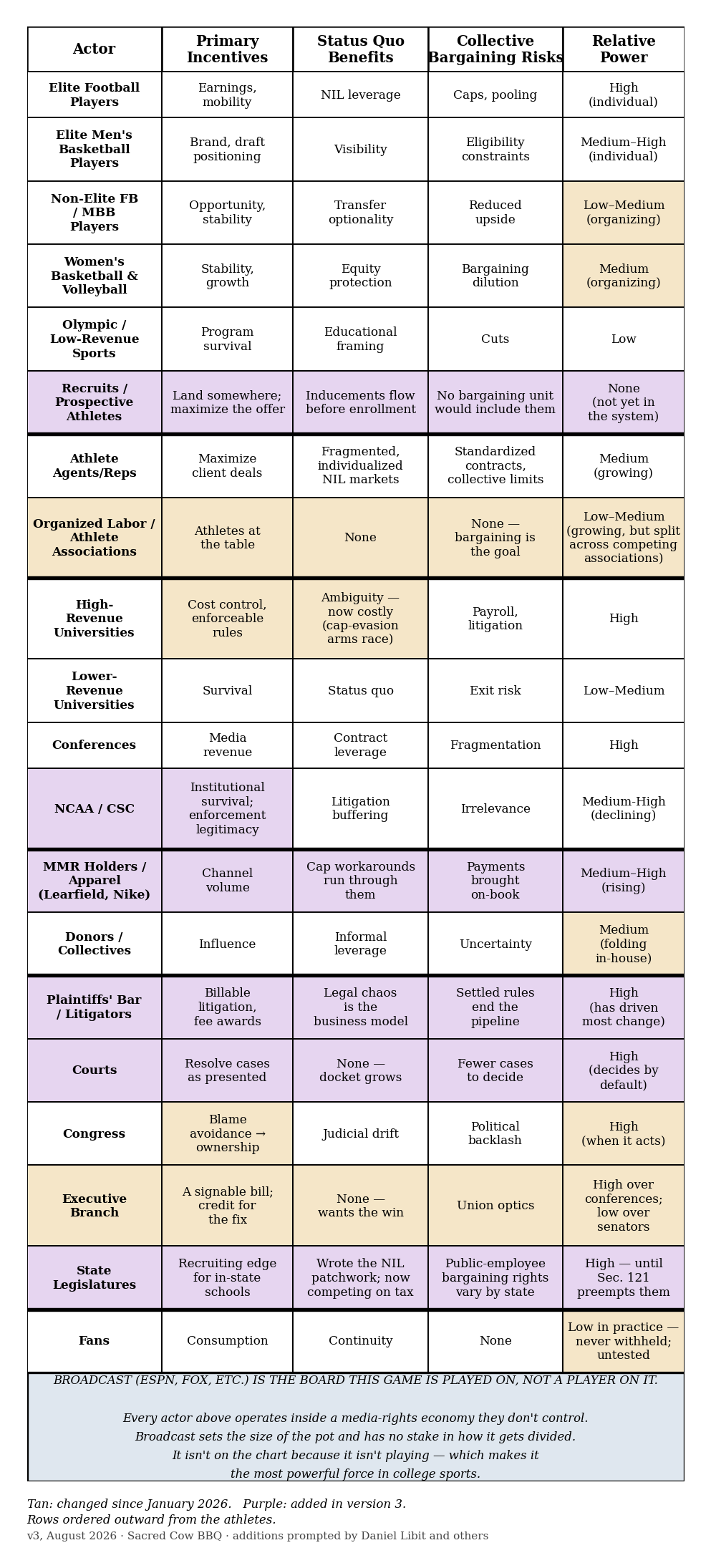
Daniel Libit asked where the third parties and the lawyers were. Fair, and worse than he put it — the plaintiffs’ bar, the multimedia rights holders, the apparel companies, and the courts were all missing. The January version was scoped to who would sit at a bargaining table, which doesn’t survive contact, because Congress and fans aren’t sitting at one either and they made the cut.
They’re all in now, along with two more that went missing for the same reason. State legislatures built the NIL patchwork, are the direct target of Section 121’s preemption, and have started competing on tax policy — Arkansas exempted school-paid NIL and revenue-share money and is so far the only state to get one enacted, with bills dying in Mississippi, Alabama and Louisiana and more filed elsewhere, while Texas, Tennessee and Florida start that race with no income tax to exempt. And recruits, who appear in the bill constantly and appeared on the chart not at all: Sections 110, 114 and 117 write rules about pre-portal contact, inducements and the recruiting calendar, governing people who aren’t in the system yet and have no representation of any kind. Their power cell reads “none.”
The two that change it the most:
Plaintiffs’ bar. Status quo benefit: legal chaos is the business model. Collective bargaining risk: settled rules end the pipeline. Power: high, and has driven most of the actual change. The actor with the clearest incentive against resolution is the one that has produced nearly every resolution we’ve had.
Courts. They decide by default. Nobody voted for Alston, or the House settlement, or whatever Johnson eventually does to employment status. When the parties can’t agree, a judge picks.
Broadcast is the part that got interesting. I added ESPN and Fox as a row, looked at it, and realized the row didn’t work. Every column strained, the collective bargaining cell worst of all, and it strained for a reason. They’re not competing for a share of the pot. They’re the reason there’s a pot.
So they came off the chart and became that band underneath it. Conference realignment is the proof to me: nobody voted on it, no court ordered it, no statute authorized it. Two networks decided which conferences would exist at what scale, and everyone else reorganized around that decision. The most powerful force in college sports isn’t on the chart, because it isn’t really playing.
The hardest question about a chart like this is how the system “breaks.” Everyone involved says it’s unsustainable and that we can’t keep going on like this. And yet it keeps chugging right along anyway — bigger ratings, more capital flows, and so on.
I’ve argued that financial pressure alone won’t do it, because a program that can’t cover its obligations usually gets help from the university’s general fund, or even its endowment in some cases, because college athletics and the experiences around them are one of the few things keeping enrollment up at a lot of places right now. Hate it, love it, either way, that’s what’s up.
That answer is about solvency, though, and solvency may be the wrong axis. A deficit is a budget story with diffuse victims and no faces. A school missing payroll to its own players is a very different animal: identifiable people, a moral script every working adult already owns, and athletes and agents with megaphones of their own. “Arkansas cuts tennis” moves nobody. “They didn’t pay the players” might move everybody.
I’d still call that an accelerant rather than a break, though. Outrage has no channel of its own, and fans have never once used the power they have. But it lowers the political cost for the people who can act, which is why the fans row now reads “low in practice — never withheld; untested.” It’s the only power on the chart that has never been exercised, and the sheer affinity people have for college athletics makes me wonder whether it ever would be.
Also, I took the list of organizations out of the labor row. There are at least five groups with a claim to speaking for athletes, and I couldn’t fit them all — so the crowding moved into the power column, where it says more anyway.
And finally, the rows are now ordered outward from the athletes: the players, then the people who represent them, then the institutions, then the commercial intermediaries, then the legal and political actors, then the fans, then the board itself. I think that helps with clarity.
And then, more changes
The version that ran Monday was up for two days before readers found the next round.
J Johnson on X made a sharp catch, I thought. Under the bill a free transfer is a one-time-use asset. Section 112 guarantees one without loss of eligibility; a second costs the athlete a year unless his sport is discontinued, his head coach leaves, he’s assaulted or harassed, or he’s off to grad school. Which is a telling list — it covers the coach walking out the door, not the coach staying put and squeezing. So after the first move the athlete mostly stays while the coach keeps every lever — recruit over him, hire a position coach who doesn’t want him — and the exit that was his whole source of leverage is spent.
Which means athlete power isn’t a fixed value on this chart. I think of it like a clock: high until the transfer is used, low after. And that cuts against the bill in a way I doubt its drafters priced. The January argument was that exit crowds out voice. A system that depletes exit manufactures demand for exactly the organizing it was built to forestall.
Tom McNamara noted that collective bargaining means different things in different states, since many states don’t permit public university employees to organize at all — which makes a national arrangement a preemption question as much as a labor one. That’s among the first threshold questions Cruz’s staff raise in the memo, and it explains something about the Oregon State petition. It was filed in a state whose law allows it. Forum selection, not coincidence. That one made it in: it’s the collective bargaining risk cell in the state legislatures row.
Sir Von flagged the high-revenue schools stuck in a conference they’d leave if they could — real money, no mobility, a different profile than the other high-revenue rows. He’s right, and that one probably belongs in its own row.
Neither of those is on the chart above. Consider them noted.
What might move things…
I mean, who can predict how this is all going to evolve. We’ve got a PCSA that seems unlikely but might still pull off the kind of comeback Michigan State got when the Michigan punter fumbled that snap (sorry, too soon?), and the rest of the college athletics landscape could never have predicted how all of this has evolved over the past year, really. But some things that came to mind while I was writing this:
What if the transfer rules change, or a waiver regime turns out to be generous in practice? The fans row could move, if the payroll scenario above happens to somebody big and folks actually get mad enough to turn the channel — though even then that’s probably a team-by-team thing. And the state legislature row, if Section 121’s preemption survives September and the tax competition stops mattering. That’ll be interesting.
Point is, the finding from the flagship post back in January survives all of it. The people who would benefit most from collective stability still mostly can’t impose it, and the people who could impose it have mostly profited from the ambiguity.
The board has gotten bigger, and it’s dynamic, which is what makes it both so daunting and so interesting.
Previously: Student Athletes Are the Subject of the PCSA, but They Are Not Much of a Party to It on the Senate Commerce staff memo, and A Mountain West AD Says College Sports Is Not a Free Market on where the January argument stands eight months on. The original grid and the full structural case are in How Collective Bargaining Could Stabilize College Football.